Skip the Process, Draw the Pixels

Yale School of Architecture/Art

Source
Yale School of Architecture/Art
Categories
Features

This conversation with Seth Thompson and Willis Kingery was originally published in Paprika!, the broadsheet of the Yale School of Architecture and Art, in November 2018. Reposted here for archival purposes.

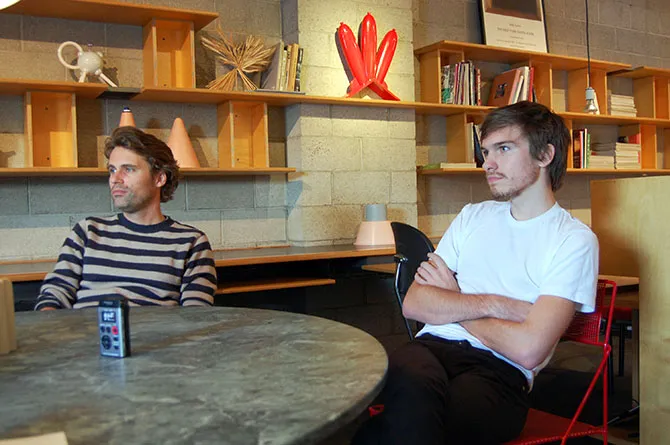
Jon-Kyle Mohr is a designer, programmer, and musician from Los Angeles. His work is methodical, technically rigorous, and at turns provocative or philosophical. In the past year, he has developed a tool to archive Soundcloud music on the distributed web, a bookmarking site, a blogging platform, and an interactive map of thoughts, images, and geospatial data generated from a walk through the Los Angeles Arroyo. Each project embodies an approach to radical transparency that includes open-sourcing code, hosting sites peer-to-peer, and broadcasting live question-and-answer sessions to share context and background.

Seth Thompson: We’ve been talking about the idea of producing a rendering by individually selecting the color of each pixel one by one in Microsoft Paint. This is a provocative idea as a piece of performance art … or at least process art. Why is this idea so compelling and what are the implications for all of the ways we otherwise produce digital images? Why is Microsoft Paint always a piece of software that gets referenced in relation to this kind of idea?

Jon-Kyle Mohr: I think about this from a place of consumption and creation. I grew up looking at images on screens, and have spent much of my adult life doing the same. At a certain point the image breaks down for me and I see it as abstract individual pixels. I find it difficult to design something, or take a photograph (forms of image making) without feeling those individual pixels on a screen. Same with audio. It’s difficult to record and process audio without seeing the audio as an image: a waveform. This affects my process in a certain way. This has more to do with biology and how the eye processes the environment, and less about a distinction between analog and digital methods or something of another epoch that existed maybe fifty years or five minutes ago. Microsoft Paint is jurassic in position relative to the sequence of consumer electronics and the graphical user interface. It’s a rock.

ST: I think, if I can make a generalization, that when you say you see abstract individual pixels, you’re also talking about a certain facility with signal processing? Like the ability to see a low pass filter on an audio waveform and envision what it will sound like, or the ability to see a photograph and recognize a certain desaturation in the highlights that you can intuit how to recreate with a set of curves or tone mapping. Or is there something else at play?

JKM: It’s less granular than that. Just raw perception. I know I’m looking at a grid of pixels and most of the time my brain couldn’t care less as it just sees an image, but every once in a while an awareness floats to the surface, usually when making something. It’s hard to bridge the gap between the nothingness of initiating a project and knowing its ultimate place on the screen. Why not skip the process and draw in the individual pixels, or just draw the waveform? This is of course a ridiculous idea, but a personal hangup nonetheless, and it overlaps with a semantic tripping point between “process” and “processing.”

ST: [Responding] as someone who makes websites, what is the substrate for a website? The site is not (usually) expressed in terms of pixels. Is there another unit of “raw perception” that comes into play? Is the HTML tag an equivalent? Or to put it differently, if you had to “draw” a website without any process (no wireframes or moodboards) and were forced to just output it to the screen what would that look like?

JKM: That’s sort of what I do. I don’t consider myself a designer, but I do design a lot of things, including websites. When I do, I’m always in the browser working with the native material at hand. In this case, the Document Object Model. There are never wireframes, or project-specific moodboards. So in that sense, my process is very direct from brain activity to final form. This is not particularly efficient; there are a lot of redundant motions, but it feels like imposing methodology on individual gesture is artificial. Working like this is closer to hand building, whereas wireframes/moodboards are more like creating a mold and casting the form.

ST: You’ve built a number of tools for others (I’m thinking about Cargo, Enoki, and some of the internal authoring tools you’ve built for institutions). Do you think about designing interfaces that encourage the same directness of intent from impulse to execution? To go back to Microsoft Paint, is there anything to be mined from its primitive simplicity? Or to put it differently, to what extent do you believe that your process (or we could even say nonprocess) is a personal artifact vs. a pedagogical tool.
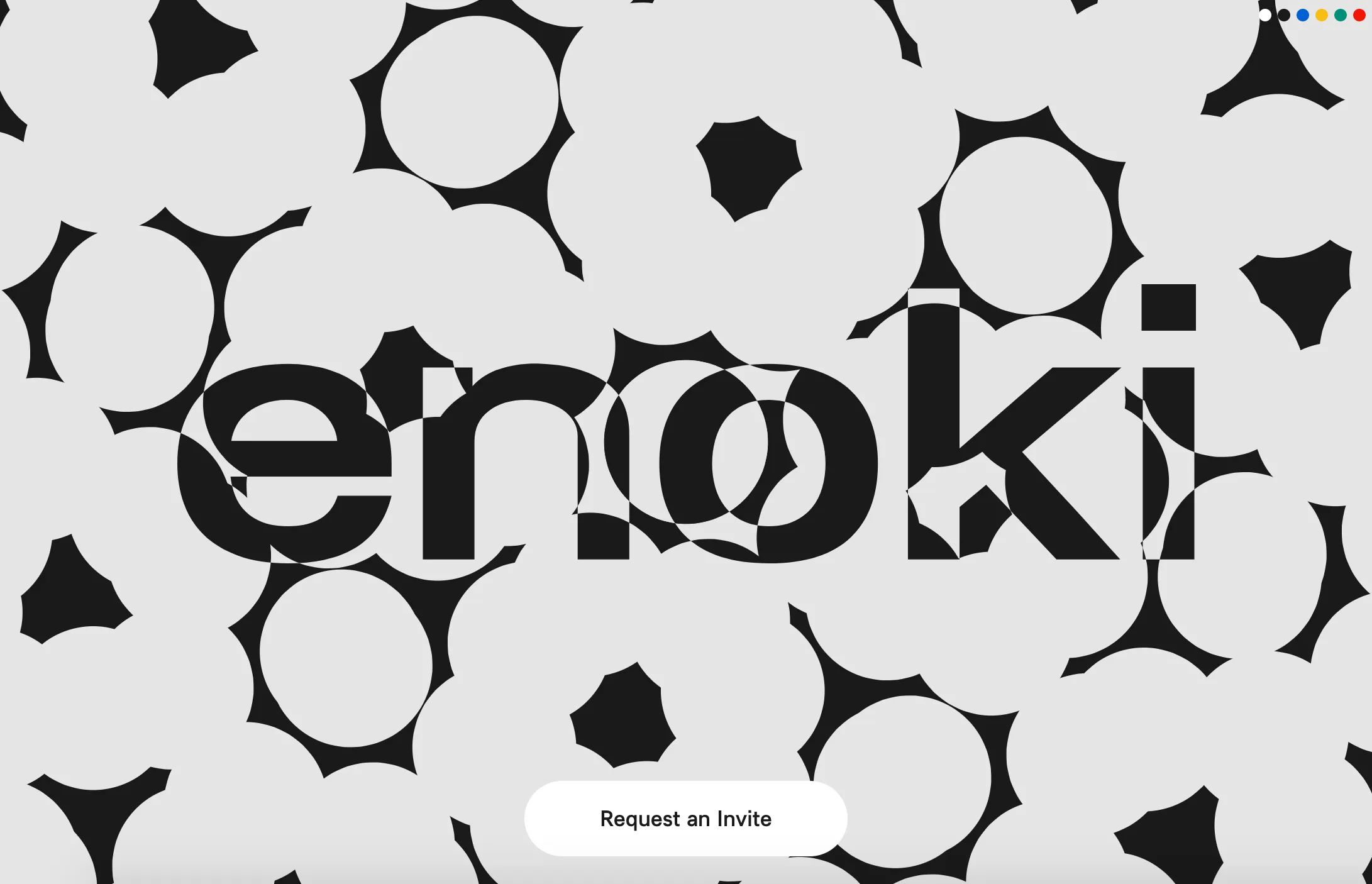
Enoki.
Enoki.

JKM: In order to create a useful tool conducive to a range of possible forms it is necessary for the design process to center around defining brokenness. Consider the visual flow of a deep neural network and try to design a “user experience” around that. Untraceable chaos. My work on Cargo was never directed by any imposing methodology. It was extremely lucid. This is because I was not creating something for a specific user but creating a flexible authoring environment for a multitude of possible applications that we could never know from the onset. This is a symptom of working in the future. Creating interface for a specific client is a more focused challenge based on the experience that client brings to the table, or the context of that particular institution. I personally find that far more of a challenge than following my nose.

ST: When people talk about image consumption they are quick to jump on the idea of the “feed” as a kind of universal interface (sometimes Pinterest is mentioned, but the reference is usually used as a stand-in for every online image stream). It strikes me that Pinterest, Instagram, Tumblr, and of course Are.na are very different kinds of image repositories. How does the interface itself, the technology underlying the interface, and the community around the interface affect the experience of browsing images on any given site?

JKM: It is interesting that all of the platforms you mention share the feed in common, yet have distinctly different patterns of use and communities. There is of course no clear answer, as these are organic and emergent qualities that seem clear in retrospect but are often unknown in the moment. I guess it’s always possible to point to style. Pinterest looks lame, and that makes me uncomfortable, so I’m not going to use it. Are.na looks “lame” in a very specific way (default sans-serif typography, desaturated UI, etc.) that aligns with my sensibilities, so I will use it, and that will connect me with certain other people, and now there is a community. These things don’t just happen (a lot of work goes into it) but I question how much one can know in the moment exactly what something is. At least I don’t.

Willis Kingery: Your point makes me ask a basic question: what would healthy image consumption online even look like? The platforms you mentioned occupy incommensurate worlds in terms of content and organization, but the mode of consumption they offer is largely the same. People lament the “feed” and feel that supposedly better alternatives exist, yet every platform offers essentially the same model for looking at images.

JKM: Right now we wake up in the morning and take a hit of fresh content. Something healthier is less like getting a fix and more like something ambient. “Oh, that’s nice. Goodbye now!” The screen is a difficult interface to work with.

WK: In the life of the image-based platforms mentioned above, each seems to start as a somewhat peripheral community, but as its user base grows, they inevitably reach a kind of saturation point, where eventually the repository goes from being a rich site of discovery to a more mainstream mood-boarding tool. Can image-based platforms scale without propagating a certain sameness of content? In relation to fringe platforms I’m thinking of some comments you made to my classmate, Steven Rodriguez, about the ongoing suburbanization of the internet as a reaction to the centralization of the Valley’s platforms, how people have been seeking online “property” outside of the center of activity, and I wonder if you still see this as a trend?

Has that movement possibly opened pockets of possibility within the “urban core” of the image economy/ecology?

JKM: And just look at how well suburbia played out! Imagine the commute to your Facebook feed every morning. Yeah, I think this is also where metaphor breaks down and it’s important to abandon the analog as its core meaning fades away. The decentralization thing is really simple: you are your data, you do not own your data, you should own your data, you should not have to be constantly aware of this. To your point about community scalability, it is important to be skeptical of the growth chart. Capitalism loves a good growth chart. It’s hard to do things within capitalism without them. Looking towards urbanisation to understand this is useful but should not be taken literally.

ST: In the past year, you’ve broadcast a number of “hangs,” or livestream updates, to a community of programmers, designers, and distributed web enthusiasts who are interested in your work. In one of them, you constructed an Enzo Mari Autoprogettazione table in your backyard. What is the significance of sharing the artifacts of your working process with such an audience? Does Enzo Mari’s notion of sincerity in individual creation have relevance in an era when code, ideas, images, and even websites can be so easily copied, modified, altered, and combined?
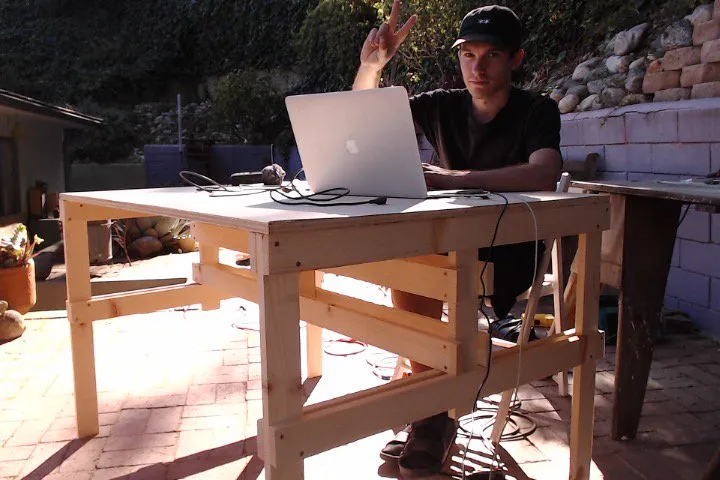
An Enzo Mari Autoprogettazione table, built in the backyard during a livestreamed hang.

JKM: Yeah, these are awkward for me but the feedback is good, so I keep doing them. I see Autoprogettazione as less about the sincerity of an individual and more about a critique of production. Enzo is not saying, “everyone should build their own furniture to truly know it.” He’s saying, “Look, build this table. Now when you look at tables you know when one is shit and why.” Not only this, he uses plain language to communicate the ideas. A similar critique on the production of the internet would be challenging considering the difference in materiality. I have difficulty imagining what this would be if not reductionistic.

ST: It’s been said that prediction is a low form of journalism, but do you have any guesses or aspirational ideas about what images we will be viewing in the future and how we will be making or viewing them?

JKM: Prediction is the ability to know the future, but exists squarely within the past. The work being done with GANs are producing entirely new forms, but the output is a hallucination of those that exist. The future of image making will probably be variations on Deepfakes, content substitution ad infinitum. The audience and the author will continue to become one and the same.

WK: In relation to future modes of viewing and the earlier conversation about pixels and having an atomized view of every image, I wonder how we’ll navigate these shifting image worlds offered by digital platforms. Is there a direct visual parallel to this condition in some of your Are.na channels, [‘Array’, ‘Aesthetics’] and Deep Field, for example? We’ll certainly be engulfed by an ever-expanding constellation of images, but perhaps its ubiquity and banality should be embraced as a generative force. It’s overwhelming, but is there value in becoming adept at searching for anomalies in an infinite field?

JKM: For me, a lot of this comes down to who owns the data? If it all continues to centralize and we’re just using Instagram, there is very little room for speculation about possible form because it will all be dictated by them. They own the land as it were. In this era of data ubiquity you mention there is room for the truly personal “artificial intelligence” or a formalized mode of augmented cognition. We already all do this “offload your brain to the cloud” kind of thing but it’s not articulated as such. Perhaps this will manifest less as decentralization vis-a-vis localization … a continuation of today’s antiglobalist sentiment as it makes its way online. As I type I begin to care less and less about this and more about finding a good snack to eat.
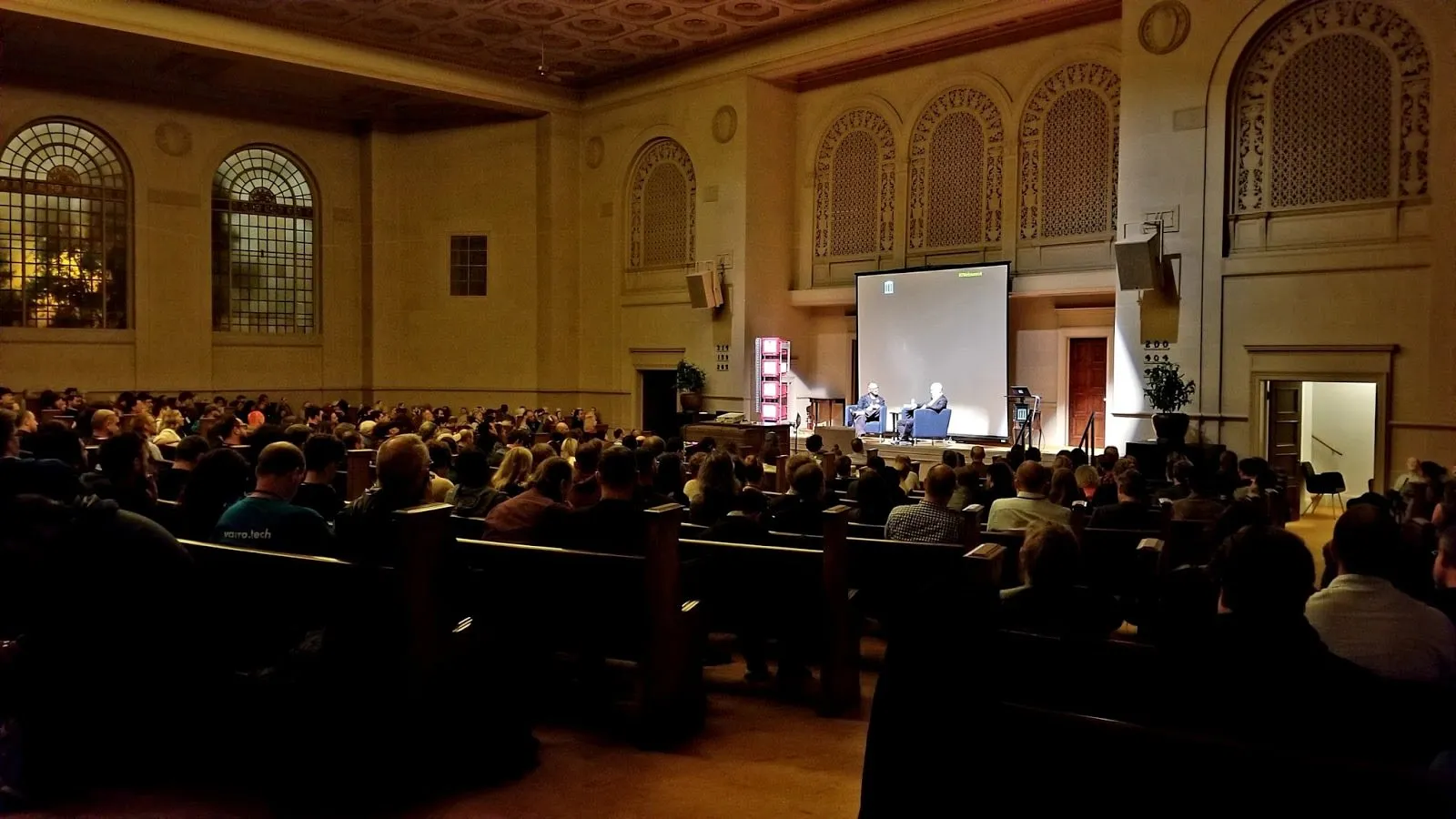
Decentralized Web Summit 2018

Are.na Editorial

Link
are.na
Source
Are.na Editorial
Categories
Features

Originally written for Are.na’s editorial, published August 13, 2018. Reposted here for archival purposes.

On the ground at the second Internet Archive summit for preserving the open web.

For those of us who grew up connected to the Internet, to say the neighborhood looks a little different now is an understatement. There has been unabated progress. Explosive development. Things are a little broken. The possibility of a future techno-pastoralism continues along the cliché of an epic edenic narrative… but perhaps not?

Photo via the Internet Archive

The Internet Archive is a church, both figuratively and literally. Founded by a ragtag group of custodians to the preservation of an earlier web, it’s a retrofitted place of worship whose facade is perhaps most recognizable as the white-columned favicon of Archive.org. It’s located on sacred ground in San Francisco, halfway between The Golden Gate Bridge and its namesake park. Here you won’t find any future billionaires rich off an IPO outfitted in Acronym and rolling up in Teslas. Instead, the archive is run by volunteers preoccupied with a history of people using technology to connect to each other, regardless of individual ideology or belief.

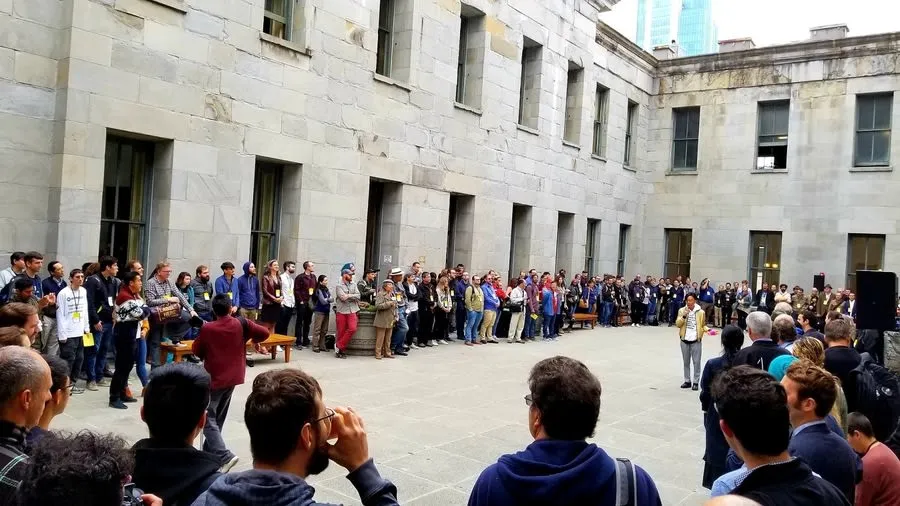
It was in the Internet Archive space that the first Decentralized Web Summit took place in 2016. In an effort to preserve the open web and evolve the discourse, the summit assembled participants inside of the sanctuary to ruminate on the theme of Locking the Web Open.

Two years have passed and much has happened. Many came down with crypto-fever. Grassroots communities interested in data-as-environmentalism sprang forth via Google Docs. America voted. Zuck (sic) went to Capitol Hill.

This year the summit moved from the church to a bank, a facade of columns in common. The substantial increase in participants and programming necessitated the additional space. The theme was similarly located elsewhere: Global Visions / Working Code.

Day One, July 31st

We left from Los Angeles as the sun was rising. After a week of 100°F+ days I found myself wondering when the “Excessive Heat Warning” will no longer be included as an exception in the daily forecast.

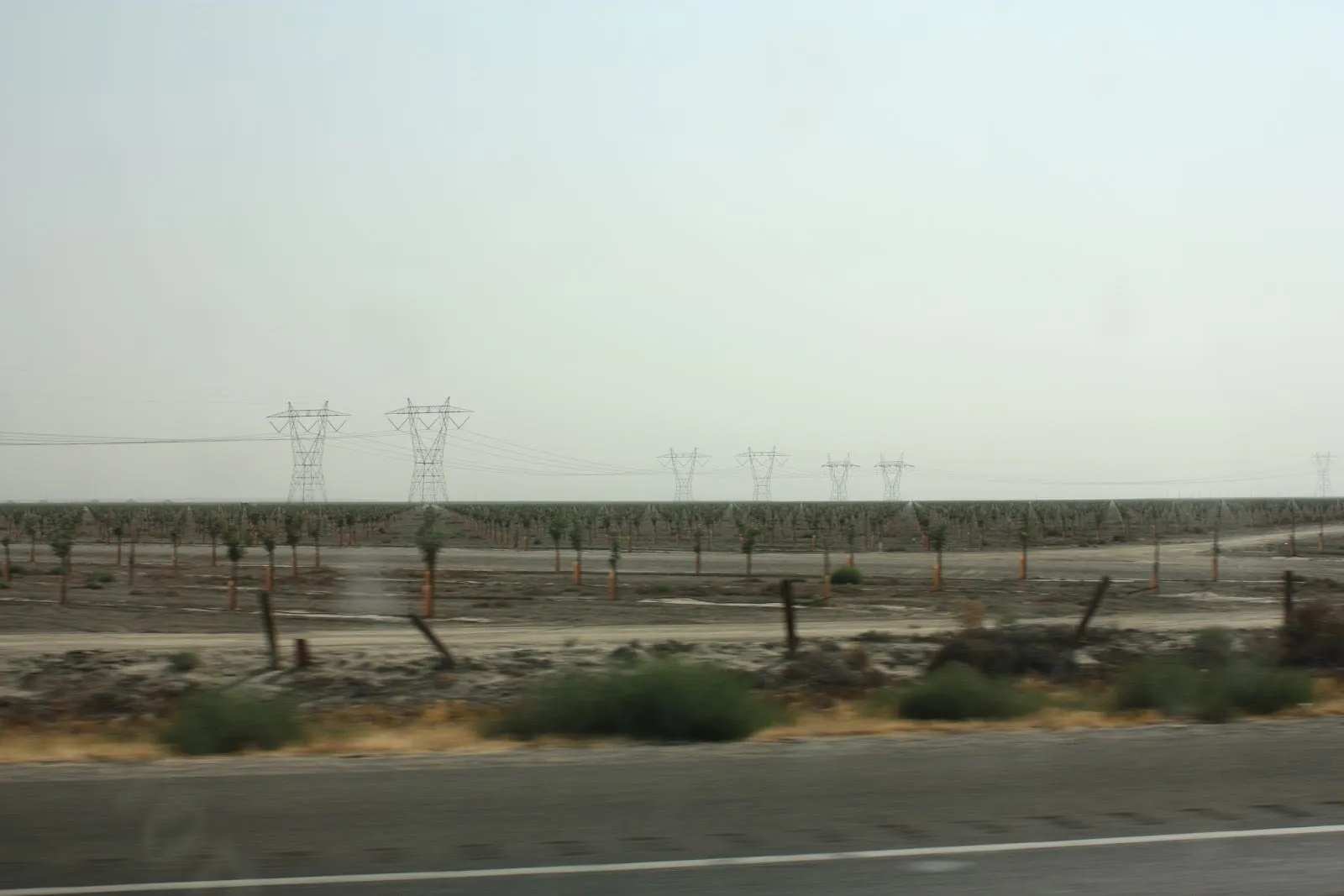
Interstate 5 (“The 5”) connects Los Angeles to San Francisco by cutting through one of the most productive agricultural regions of the world, which provides a significant amount of the country’s nutrition. Handmade signs line the interstate along the edges of fields, commentary on the truly scarce resource in the region.

“Food Grows Where Water Flows!!!”

The opening party was held at The Archive, and upon arrival, that particular type of anxiety produced by seeing a sea of faces a little too much like your own began to set in. The reaction is twofold; it’s unsettling to realize both how generic you are, and how homogeneous the people involved in the discourse continue to be.

With this in mind, it was perplexing to many why the kick-off party featured an interview with Mike Judge, creator of the popular HBO show Silicon Valley. Granted, the current season features the cast attempting to “drain the cloud” and overthrow the archetypical platform (Hooli) by creating a peer-to-peer protocol. Bringing the participants down a notch through self deprecation was welcome. However, shortly before reflecting on his inability to strategically manage wealth, Judge went ahead and squeezed in a quip about female underwear models and female programmers, prompting everyone’s eyes to roll in perfect unison. Judge appeared visibly uncomfortable, and so were we.

Afterwards a friend summarized her reaction perfectly, saying something along the lines of, “I sure hope they didn’t pay him to attend after having asked for a list of (and then not inviting) several POC who were unable to afford the $1400 ticket.”

My bubble of friends dispersed and we all headed off to our respective AirBnBs by taking Ubers and Lyfts after Yelping a place to eat.

Day Two, August 1st

The day began in the courtyard with an introduction from the organizers and a playful exercise in networking by Taeyoon Choi before his Distributed Web of Care workshop. At any given moment several workshops, panels, or talks were happening concurrently. Although the intent was to meander more, I quickly realized which rooms contained the programs I found fascinating, and frequented those. (The hardcore cryptography workshops and panels on governance were simply outside my generalist range of understanding.)

Photo via the Internet Archive

First up was a workshop on Beaker Browser, an experimental browser that supports the peer-to-peer Dat protocol. It was my first exposure to p2p publishing several months ago, and is the environment I find most enjoyable to work in.

Just down the hall were Laurel Schwulst and Kyle Mock with their p2p2p2p workshop, which guided participants through publishing a personal website on the peer-to-peer web with Beaker Browser. Participants completed a short survey about “virtual houses” to generate content that would populate their new personal sites. It included questions such as what happens in your space, and who is there? Laurel and Kyle then provided a simple template site to fork, and we customized our cyber-abodes. In an age of personal brands, there’s a clear richness to understanding personal online presence through the lens of domestic space and how we inhabit it.

Afterwards I wandered down to the basement of the bank. Tucked into one of the vaults was Distributed Gardens, a site-specific installation designed to exhibit the technical and creative output of the summit. It also functioned as a critical breath of fresh air, as the room was mostly occupied by fellow misfits.

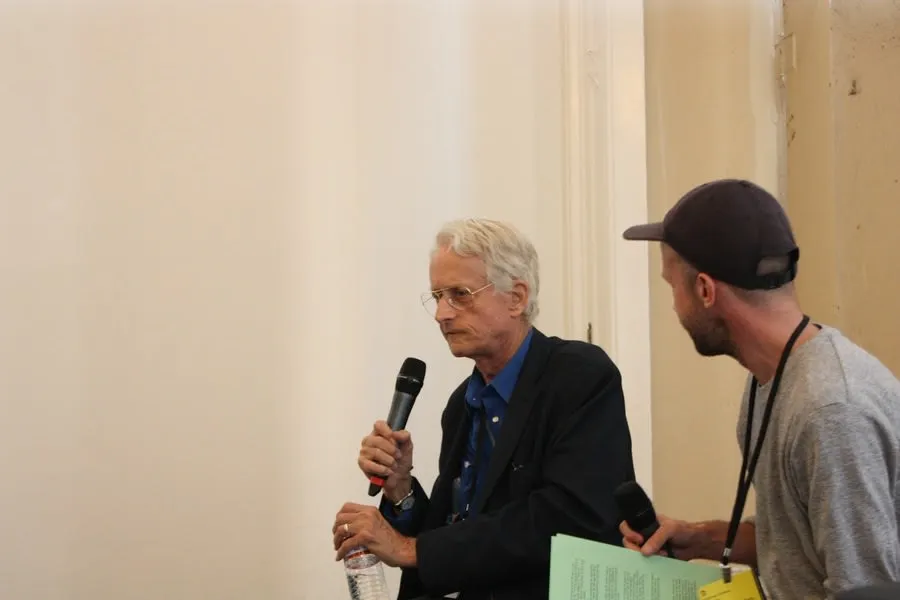
My day rounded off by catching a surreal interview of Ted Nelson by Are.na co-founder Charles Broskoski, which began with Ted theatrically checking his mic by reciting a full several minutes of Hamlet from memory. Charles asked about Ted’s Xanadu project, the perpetually-in-progress origin of hypertext and precursor to Hypertext Markup Language (HTML). One question that stood out was that of being burdened by a good idea. There is a certain weight in feeling the responsibility to execute. To solve problems.

Next was a lively conversation between hypertext researcher Cathy Marshall and the musician and journalist Claire L. Evans, during which they reminisced about early hypertext culture and non-linear poetry; the social stigma attributed to contracting for the CIA; and other memories of Cathy’s time at Xerox PARC. At the end Cathy quipped on what her mother’s reaction would be to her speaking in front of an audience with unbrushed hair. “But it’s important to be authentic.”

Ted Nelson and Charles Broskoski

My day ended back down in the garden basement with many others from the creative track, a portion of programming that grounded decentralization in creative thinking. Co-organized by Mindy Seu and Sam Hart, it involved many familiar faces from the Are.na community. The number of talks, panels, and workshops at first appeared overwhelming, but ensured everyone had some way of fitting in, something I was thankful for.

Day Three, August 2nd

The previous evening’s festivities had me running a bit behind, and I arrived back at the bank around 10:30 am. After some coffee and reconvening with others in the basement garden, I headed upstairs to attend the “Internet as a City” workshop.

Organized by a group of students and teachers from MIT’s Media Lab and Architecture departments, the workshop viewed network connectivity through the lens of the built environment. From the workshop webpage:

If the Internet were a city, what would be its roads, buildings, and parks? How do people, businesses, and governing bodies produce insights into the qualitative characteristics of distribution beyond the tired triptych of centralized, decentralized, and distributed?

Network as environment. This has been on my mind a lot, as it has many others. Is it possible to set aside digital areas as open space, similar to public parks surrounding urbanism?

The "Internet as a City" workshop

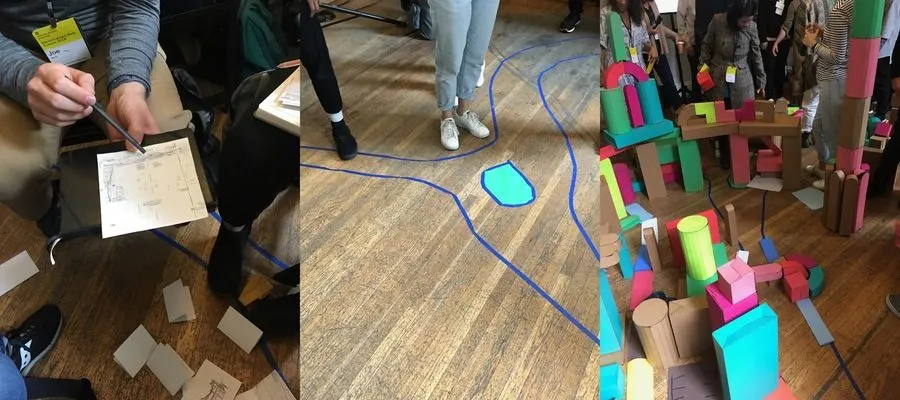
The workshop involved three exercises, the last of which required the use of a few hundred cardboard boxes of varying shapes, colors, and sizes, all having been laser-cut at MIT and flat-packed in luggage to the summit.

Everyone reassembled into new groups of five and was delegated a collection of cardboard blocks and colored paper. Each participant in the group had to pick from a stack of cards that would assign them a responsibility: the state, the private interest, the user, the architect, the anarchist, etc. Each member would take a turn in constructing the city by placing a few blocks and explaining the rationale.

Collaboration and friction between members emerged, and quickly spread to other “cities” throughout the room. Some built close to the masking-tape river, others built public parks, and there were even a few toll-roads.

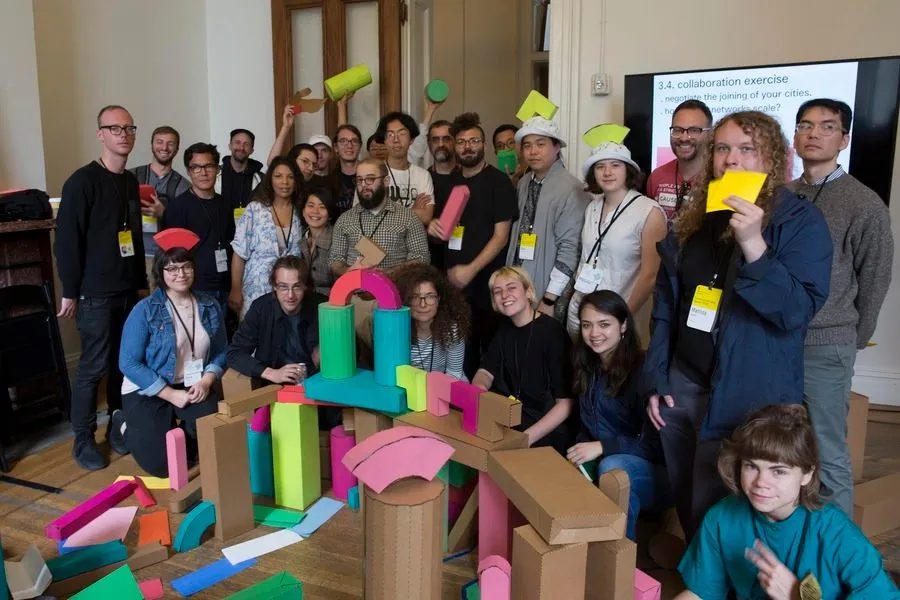
We took a break and evaluated our progress by sharing our processes. One group put most of their effort into building the tallest structure in the room, a narrow cardboard skyscraper reaching several feet. It’s role was that of panopticon, sucking up data and piping it back to partner cities.

The mood was jovial (it was play) but ultimately the cities took a very centralized form. Perhaps these monolithic tech platforms we are so critical of are not so much out to get us, but rather are the manifestation of these same decisions being scaled up. It’s all fun and games, relatively speaking.

“Your task is to now decentralize the cities.”

"internet as a City" participants

Some cities began talking to each other in attempts to broker agreements amongst themselves. Others went straight to the panopticon tower to set up remote locations in an effort to reduce the height of the tallest structure. One began investing in missiles.

The workshop acted as a sort of therapy. Rather than construct a utopian city built upon a foundation of decentralization, most participants seemed to LARP what they perceive around them in their daily lives, exaggerating the wrongs to a comedic degree. “Let’s gentrify the areas around the train station to raise rents!”

After the last of the sessions many of us in the basement garden went out for burritos. Later we migrated to a mansion near Nob Hill for an after party. Perched high above the city, we sat around and drank, surrounded by a panoramic view of downtown. A book on the shelf next to the grand piano detailed the nuances of navigating life as a founder. How to keep your money. How to grow your money. How to learn who to trust. It felt like a continuation of the somewhat dystopian outcome of the workshop earlier that afternoon: You are the tech billionaire outfitted in Acronym who drives a Tesla.

Day Four, August 3rd

We left late in the morning for the drive back to Los Angeles, this time opting for the slower route down Highway 1 (“The 1”). It had just reopened after a section was taken out by a landslide more than a year ago.

The drive along the coast takes several more hours than driving up The 5. There would be plenty of time to reflect on the past few days.

Nearing the city’s edge, we hit dense fog along the coast, and it would stay with us in patches the rest of the trip. My path through the summit felt similar. We talked about how there was a heavy amount of solutionism hanging over the summit. “In the future we will look back on someone, somewhere, who while at the summit wrote on a napkin the solution to save the world.” This attitude feels somewhat dated considering the state of the industry. To say these issues are to be solved by technology is naive at best. At moments during the summit, it was difficult to see through the clouds of hype, but it was encouraging to encounter those who continue quietly doing the work to understand these complicated issues comprehensively.

There is always palpable energy coming off a gathering of people this size who share a common goal. It creates a sense of infinite possibility, which I believe to be accurate. But what happens the next day, week, month, or year? What do we do with that inertia?

Members of the Are.na team and I have had conversations for some time about ways in which to progressively introduce parts of the peer-to-peer web to the platform. Even when your intentions are to make the Internet a better place, many questions still arise when considering the possibility and how it relates to actually making something. Does the common person care about data ownership? Is the time better spent elsewhere solving less esoteric problems? Is the timing right? Is the culture there? This is to say nothing about the pragmatics of making a company financially sustainable, invisible geopolitical forces at play, etc…

Ultimately the realities of these questions are slowly revealed only through active engagement. At a moment overwhelmed by speculation, a thoughtful gesture goes a long way. That is to say, progressively gaining understanding through experience.

We continued our drive south towards Los Angeles, the fog thickening during sunset. When considering the seemingly infinite variables affecting the peer-to-peer/decentralized/distributed movement within the environment at large, the summit appears to me as an atmospheric condition. A high pressure system pushing through an upper level low.

Jon-Kyle Mohr is an independently curious navigator of the open web.

This interview was conducted by Geoff Manaugh and Nicola Twilley, originally published to Venue in 2012 and republished by The Atlantic in September 2013. Reposted here for archival purposes.

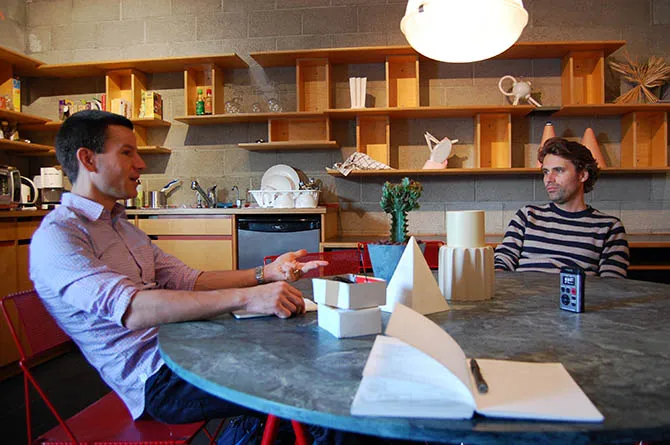
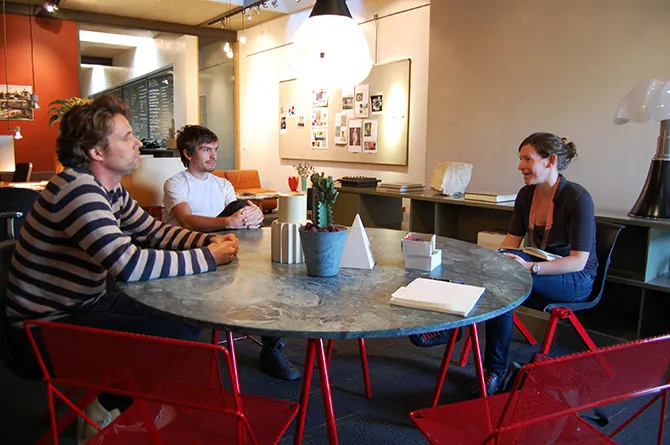
Geoff Manaugh and Folkert Gorter at Superfamous HQ.

At the risk of seeming recursive, Venue stopped by Superfamous, the Los Angeles-based design studio behind our own graphic identity and website, to discuss the architecture of the Internet and the process of exploring and expanding its potential with Dutch interaction designer Folkert Gorter and developer Jon-Kyle Mohr.

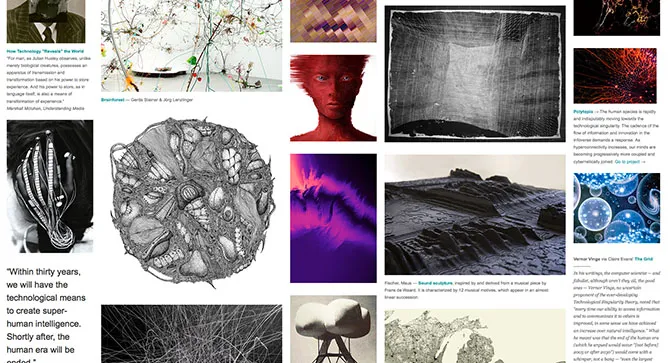
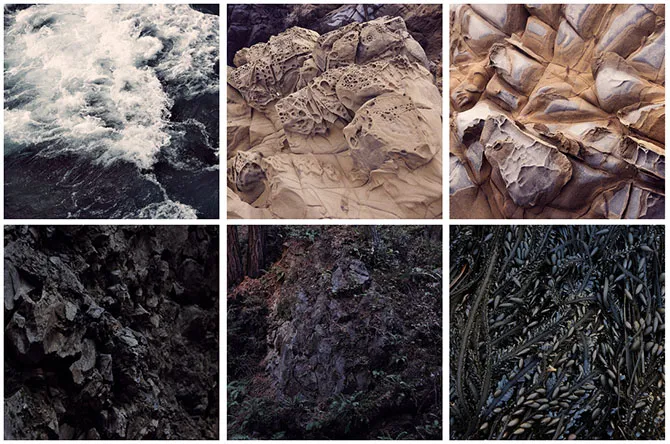
As the co-founder of online networks and creative communities, such as Space Collective, Cargo, and but does it float, Gorter’s perspective on the Internet is deeply influenced by the sixties-era counter-culture in which the early web’s artist-engineers were immersed. The design projects he regularly features on but does it float, in addition to his own quite stunning photographs, often feature other-worldly landscapes, surreal geological forms, computer-generated geometries, and more, as if part of a visual quest to uncover the programming and code beneath the forms of the world, the frustratingly inaccessible HTML behind planets, continents, oceans, and skies.

Mohr, meanwhile, comes to programming from a lifelong background in drumming and sound art; he pointed out, after our interview, that he had more or less grown up inside a recording studio. Like Gorter’s formal interest in extreme landscapes, Mohr’s musical tastes veer toward patterns, mathematics, and code, finding unexpected polyrhythms through experiments with wires, electricity, and back-of-envelope calculations.

Our conversation ranged from psychedelic science fiction to scroll bars and the future of skeumorphism, all the while asking what it means to inhabit virtual space.

Space Collective, “a cross-media information and entertainment channel for post-ideological, non-partisan, forward thinking terrestrials,” was co-founded by filmmaker Rene Daalder and designer Folkert Gorter.

Folkert Gorter, Jon-Kyle Mohr, and Nicola Twilley at Superfamous HQ.

Geoff Manaugh: Folkert, we were joking on the way here about something you said in an interview once on Los Angeles, I’m Yours. Back in 1994, apparently, you had the realization that you were going to dedicate your life to the Internet.

Folkert Gorter: [laughter] I can’t believe you read that!

Manaugh: Where did that realization come from? What made you want to work in online design?

Gorter: I was at the School of Art, Media and Technology in Utrecht, one of the first schools in Europe that took the virtual, digital revolution kind of seriously, although it wasn’t a revolution yet, but its emergence. They brought in a lot of conceptual thinkers to talk about, well, it was not really the Internet back then. It was more like CD-ROMs, multiple-ending films, parallel storylines, and so on.

It was interactive thinking: where information technology meets interface design meets art and education. The more conceptually inclined people who were professors at these schools were almost psychedelic, I think. They came straight out of the sixties and seventies counterculture in California.

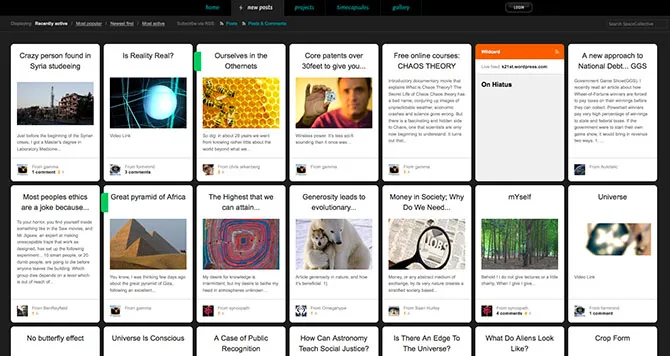
New posts gallery, Space Collective.

As interactive design went online, these people who I really identified with, these artist-engineers, were the ones who were asking how they could put their stuff online. And they started making art specifically for what was possible: the basic things that you could do in the rudimentary browsers at the time, like Shockwave and animated GIFs and trying to figure out how you can scroll more than the height of a browser to show more content.

I think that group of people, who first came to the Internet as artist-engineers, completely set the tone for what the web is now. For example, browser standards are totally based on what was being pushed back then, in terms of multimedia content.

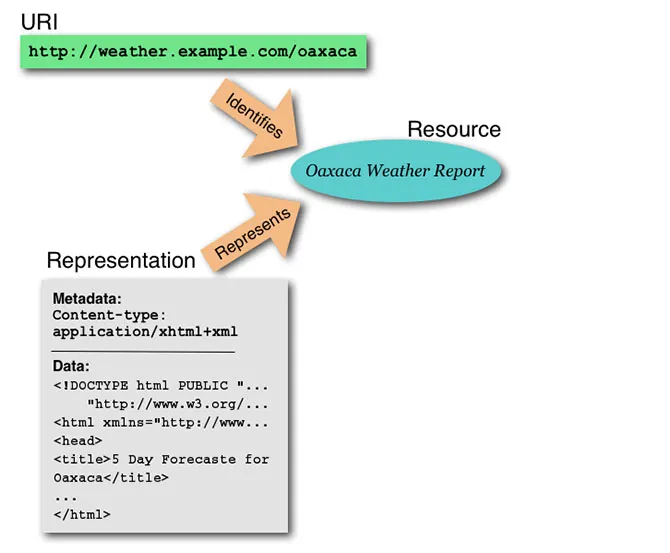
Diagram showing the relationship between identifier, resource, and representation, from Architecture of the World Wide Web, Volume 1.

Nicola Twilley: Are you implying that the Internet could be quite different today, if different kinds of people had been experimenting with it at the start?

Gorter: Right. That’s what I think. Take, for example, blogging. I think blogging probably became popular simply because it became possible to scroll vertically in web pages.

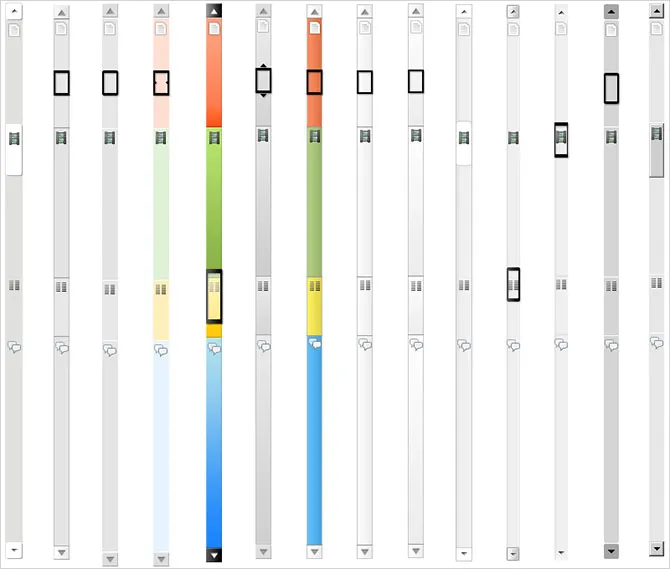
Before blogging, before vertical scrolling, there was a 640-by-480 screen, and everything that didn’t fit had to go below the fold. That was a disaster, because people couldn’t scroll, which meant you had to make all sorts of new interface artifacts (“previous” and “next” buttons, page folding, and God knows what else) until people finally said, “Screw it. We need scroll bars.”

That’s why I call them artist-engineers, because they were making a medium that was able to carry what they wanted to express.

Of course, scroll bars already existed. They were carried over from all the other OS technologies like Windows, which is why they also get really high system priority: the mouse and scroll never lag because they’re driven directly by the operating system. It wasn’t that the concept of scrolling was new, but it was definitely one of the innovations that was necessary at the beginning of the web in order to push the amount of content that you could show on sites.

Scroll bar design, Chris Norström.

Gorter: The scroll bar is a great device: I have always been most excited about it as my main user interface device. Way back, I started experimenting, along with a whole bunch of other people, with making scrolling interfaces. I would put up a ton of content, but you couldn’t see all of it. It was as if the browser was the viewfinder of a camera, and, instead of moving the viewfinder, you could just scroll the page.

Manaugh: Based on some of the images and quotations that you put on but does it float and Space Collective, from people like Timothy Leary and Terence McKenna, as well some of the things you’ve said in the past about wanting to see how human culture could move online, there seems to be an overlap between your interest in information technology and an almost psychedelic interest in things like the “Singularity.” I’m curious as to how those two strands weave together for you, if one led to the other.

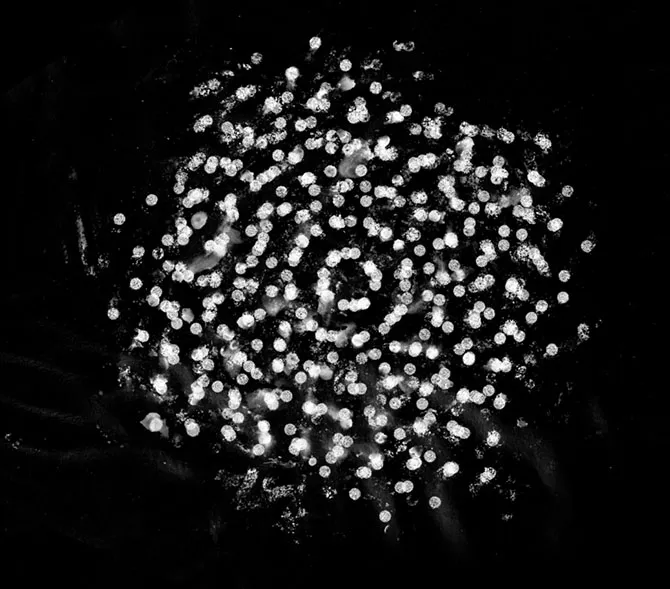
Screengrab, Jon-Kyle Mohr.
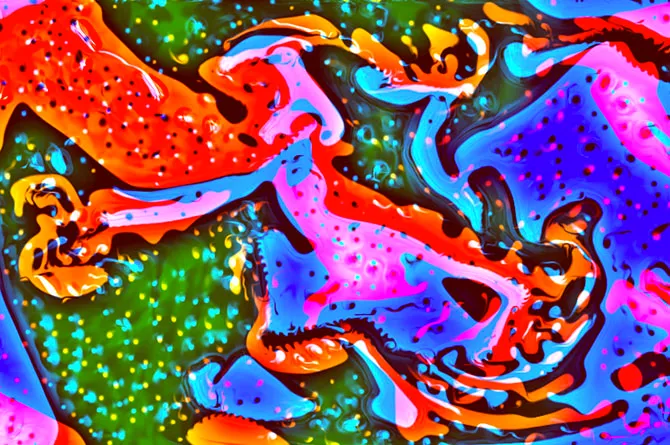
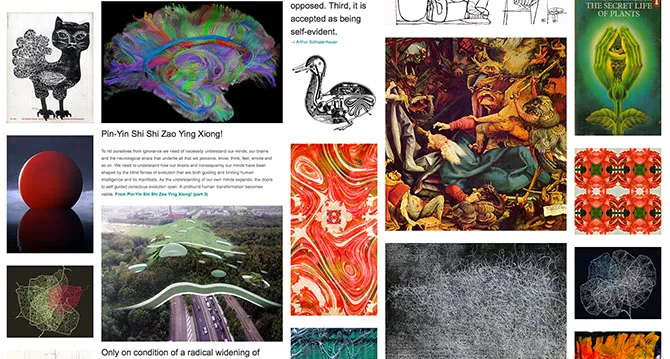
Screengrab, fluid simulation with Turing patterns, linked by Folkert Gorter.

Gorter: I’m really glad that you picked those things out. Those are the peaks of the landscape that I try to hang out in, pretty much. The web is a space of infinite potential, especially when I first met it, and it has not been charted. We can only go as far as our current interfaces and technologies let us go, in the same way that human language gives us a territory in which we can dwell, and it’s almost impossible to get outside of that.

I’m really excited about trying to make that space bigger: to create more land, as it were, the way the Dutch use ever more sophisticated technologies to pump out water and now we can live on the sea floor.

To bring that back to the psychedelia thing: for me, that feeling when you dive below or beyond or above language, when you’re in that zone, that is very much akin to being on the Internet. You can be somebody else. You don’t even have to be a human. You can speak using media.

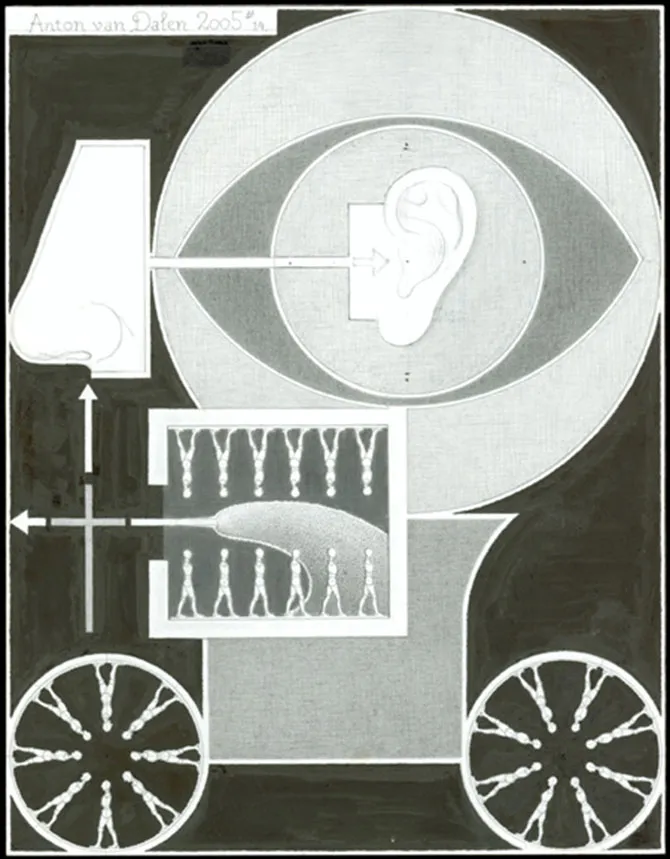
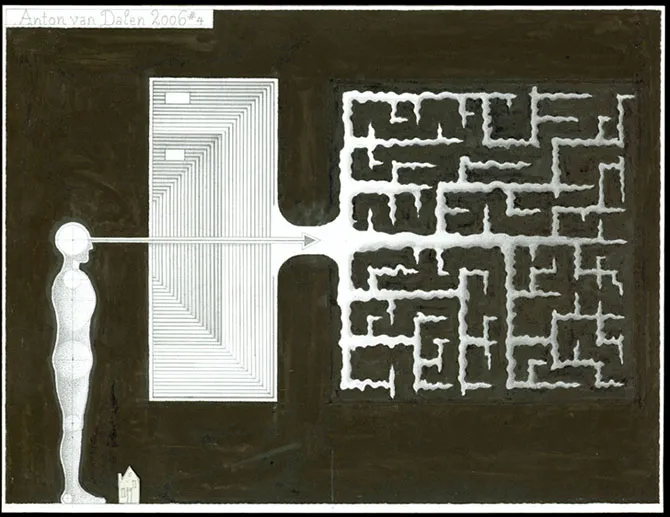
Artwork by Anton van Dalen, posted to but does it float?

Gorter: Do you know the book Starmaker, by Olaf Stapledon? At one point, the narrator has evolved so far that he’s using the brains of different organisms as hosts. He’s sharing the minds of a flock of birds sitting on some mountainside, describing the amazing sensation of feeling an entire mountainside through a collective, distributed mind. He says (and I’m paraphrasing) that it was almost as though a blind race, through technology, could have invented organs of sight.

Manaugh: He was using the birds as a browser.

Gorter: Right. The Internet is a sensorium in the same way. Thinking about it as a biological, technological extension makes a lot of sense to me. What’s mainly interesting to me, at least right now, is that you don’t carry the limitations of the body with you in the virtual domain.

Twilley: So the limitations of this virtual world come from our interfaces: both the hardware and the software. Can you give some examples of things you’d like to do but can’t because of these kinds of technological limitations?

Jon-Kyle Mohr: Some of the stuff that we’re starting to explore right now is only possible because today’s browsers are capable of enabling it. Before, there were technological obstacles like latency. Latency is the bane of my existence. If you do something, you want to feel as though you’re affecting it, and not that there is a 15-millisecond lag: that there is latency. That’s what’s so great about your phone: you flick it and it responds immediately. It feels like you are actually manipulating it.

To give another example: right now, everything uses the metaphor of a page. We’ve been playing around with Z-space, that is, breaking out of the metaphor of a page and moving into three dimensions, the X, Y, and Z axes, but still within a browser. People have been playing around with how to represent three dimensions forever, but figuring out how to do that within the interaction history of the browser is particularly interesting.

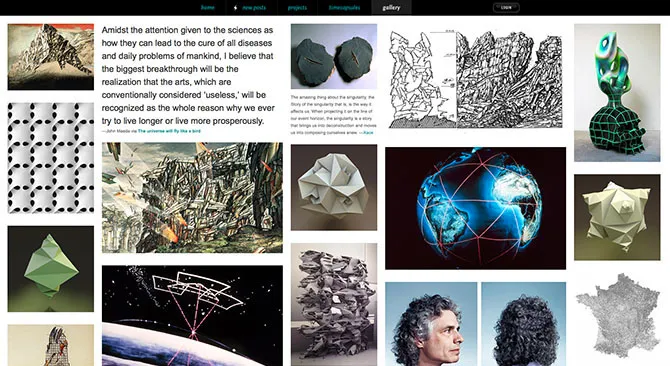
Screengrab, gallery, Space Collective.
Artwork by Anton van Dalen, posted to but does it float?

Gorter: Virtual reality has been the frontier forever, and people have thought about it as if you were walking into a big sphere or you were wearing goggles and all of that. But, to me, thinking about virtualizing ourselves is much more interesting if you think about expanding what is possible online.

True Names, by Vernor Vinge, is a really great book to read on this subject. He lays down a lot of amazing metaphors for inhabiting cyberspace.

I mention that because what we’re trying to do with a Z-space interface is reintroduce the whole notion of the peripheral. Part of it is to do with the Tumblr and Pinterest thing: all these people posting millions of images and the way that styles seem to emerge from that stream.

If we compare vertical scrolling in blogs to driving in your car in a landscape, what we want to do now is lift off and be able to see all these image feeds, for example, as geological strata. If you’re flying above the landscape at 30,000 feet, there’s stuff to see, stuff you can’t see from your car window. That’s how we want to enlarge or expand the interface.

Flickr gallery, Folkert Gorter.

Gorter: What we’re talking about now is really more of an actual environment, in which everything you see informs how you see the things around it. That’s one thing we want to accomplish with this interface, so that when you’re looking at one visual, you can also see it as part of a pattern: you can see all of its connections.

Back in the early days of the Internet, these artist-engineers I was talking about pushed for browsers to be able to handle what they wanted to do. We still have that power. Whatever the W3C sets as its standards is just based on what people want. With the whole web 2.0 fiasco, let’s be honest, it’s as if people stopped really pushing new things, because everyone was just happy together, using Facebook and Twitter and pushing their shiny social buttons.

But we need to keep pushing new stuff. It’s a really delicate process, because if you push too far, then it’s going to be clunky and no one’s going to be able to use it; but, if you don’t push far enough, there’s not going to be any change and it will never catch on.

Folkert Gorter and Jon-Kyle Mohr at Superfamous HQ.

Mohr: It’s an accessibility thing. You have to make sure that you’re still innovating, but that you’re not excluding everybody from that innovation.

Gorter: Because if you’re excluding everybody, then there’s no critical mass.

Mohr: Degradation in digital design is also really interesting: it’s almost like time-travel, in a way. If you try to look at the Wired website on a browser that was last updated four years ago, it’s going to look like hieroglyphics.

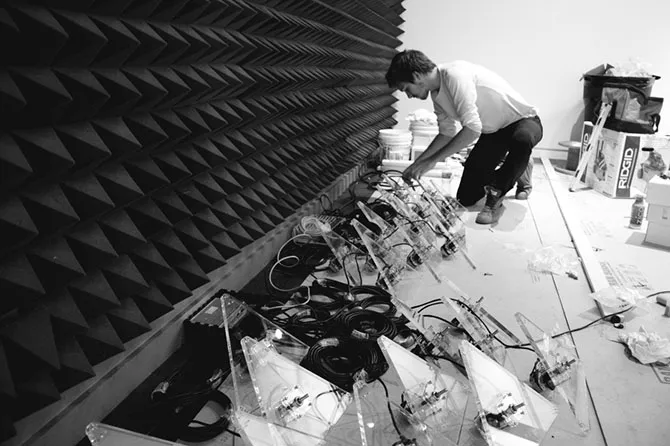
Jon-Kyle Mohr working on a sound installation.

Manaugh: Jon-Kyle, you’ve done a lot of sound-related work. How does that relate to your online design?

Mohr: There’s a lot of overlap. A lot of sound design is just designing space, and directing the ear’s attention to certain things: how you use one rhythm to offset something else, for example. Then, all the looping and cloning translates to pagination and scrolling really well. It’s all math.

Gorter: I remember you saying that you credit being able to program to being a drummer.

Mohr: Totally. They’re both additive and subtractive processes. They use the same metaphors. They loop and repeat in similar ways. It’s actually kind of funny, because, ever since I started to do a lot of the programming with Cargo, it’s influenced how I perceive music now, as being much more programmatic.

Twilley: I love this idea of useful metaphors. If the browser is to be more than just a “window” and the web is to be made of more than just “pages,” where else might you go to find new metaphors that could expand what we can do online?

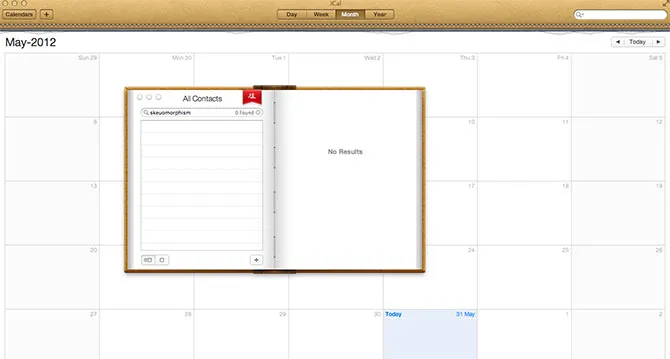
Mohr: Those are great questions. Skeumorphism was such a hot topic last year, and it was that exact same question, asking about the extent to which you need to be literal with your references versus the extent to which you can be more free and abstract.

Apple's skeumorphic calendar design.

Gorter: I think the way we get around this is that we try to not make a specific interface. Instead, we always use the content as the interface. This is how we always design. In Cargo, there’s no design, there’s just content. You click on a thumbnail, but the thumbnail is just a smaller representation of the project.

Essentially the browser is the canvas, it is the design, whereas, with a lot of web design, you see people making designs inside the browser, like a box inside a box, and then shading here, adding a bar there.

But we don’t do that. We try to disappear.

Twilley: You’ve described Cargo as not social but rather collaborative. That difference between closed and open, complete and unfinished, is really interesting. There are actually not a lot of middle spaces on the Internet that manage to straddle that division, whereas Cargo is populated by user content but still feels aesthetically coherent.

Gorter: I think, again, that’s because the design is the way the interface works, rather than being some kind of overlay.

Even if you completely disassociate your personal site from the platform, the brand is the interface. We care so much about the feel and the behavior of the interface (when you click something, something happens to bridge the waiting time between the click and the response, and the typography is always properly in proportion) that it still feels like Cargo, at the end of the day, no matter what it looks like.

Screengrab, gallery, Space Collective.

Gorter: You’re in a structure, but the only things you see are content.

Twilley: Most of the time, when you enter a social network on the Internet, the structure is very visible. If you’re on Facebook, for example…

Gorter: Everything is a dull blue. [laughter]

Twilley: It seems to me that you could maybe split the Internet between broadcast and community. Those two different kinds of platforms have very different design aesthetics.

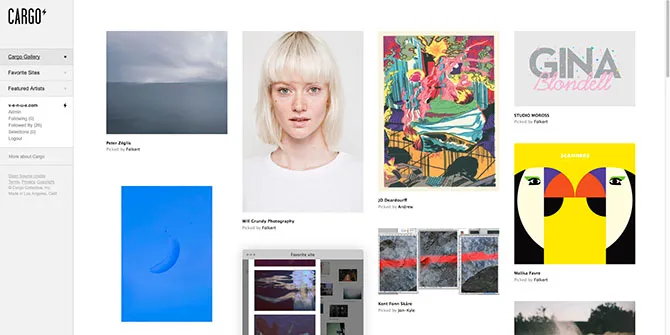
Screengrab, Cargo Collective gallery.

Gorter: I think that’s true. We are always trying to find out where we are, between those two poles.

We’re now working on something called trace-marking. It essentially started as favoriting images across the Cargo platform. It’s one of a few attempts we’ve made to go a bit more into the community direction. The thing about Cargo is that, although our community is definitely there, it’s built on people digging how we do stuff, then trusting us with their material.

We have implemented a few community things, though: you can follow people, and there’s internal commenting. We built that functionality for student networks that we’re now running with UCLA and Art Center College of Design, and a few other places.

This new trace-marking thing is a way to visually connect. If you see an image you really like, you can save it in your own space and you can create categories for how you want to save it, whether it’s for reference or simply to tell somebody that you love their image. It becomes a visual collection tool mixed with a book-marking functionality.

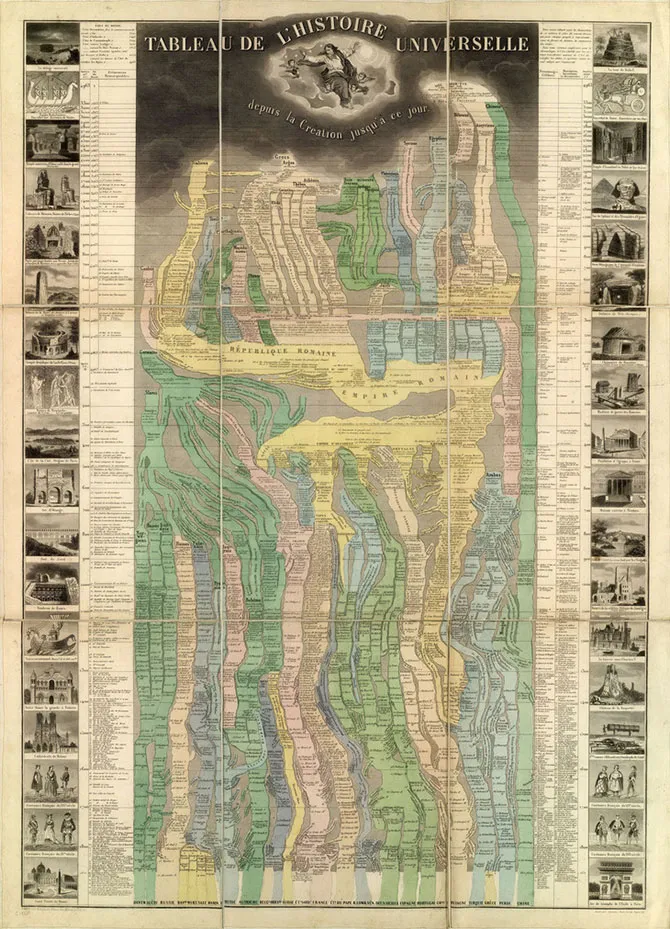
Tableau de l'Histoire Universelle depuis la Création jusqu'à ce jour, 1858, posted at Bibliodyssey, posted to but does it float?

Gorter: But this is really early days. We always let the process determine the outcome. Today, Jon-Kyle made the first steps: you drag an image, a little shelf opens up, you put it there… So now we have to figure out: what’s next?

Twilley: It seems as though images are the quickest thing to get detached from their source online.

Gorter: Exactly. That’s always bothered me! Tumblr does a great job of showing the thread of reblogs, but then no one gives a fuck about who made the original image. Creating that kind of trace for images is important.

Manaugh: Our final question, just to bring it full circle, is about the process of working on the Venue website, and whether that allowed you to explore any new territory. Perhaps it did, perhaps it didn’t.

Mohr: The integration with Google Maps for Venue was really fun. I had never used their API. We’re actually starting to work on an API for Cargo, and working with Google Maps’ API for Venue really influenced how I’m approaching that.

It was also really fun to play with spatiality. Google Maps is already interesting in terms of its Z-space functionality: the way that you can zoom in and out in satellite view, and we spent a long time playing around to find a comfortable zoom level for Venue, and so on.

Screengrab, Jon-Kyle Mohr.

Gorter: It was a great project for us, I think, because we’re always looking for excuses to extend Cargo’s functionality. The only reason we make new stuff for Cargo is in response to a specific request. We never say, “Hypothetically, people would love such-and-such new feature. Let’s make it!”

And, because we don’t design websites (we don’t make layouts, we just put content in), the Google Maps integration is not simply decoration. It’s actually integral to how the site works. What I really love about what we accomplished was that we put the Google Maps in there, but we imposed the Venue aesthetic over top of it.

We’ve done projects with Flash before where we work the same way. The problem with Flash is that it’s like an aquarium: all the content sits behind a thick layer of glass. You can’t touch it; you can only look at it. It’s imprisoned. What we’ve done is use Flash in a new kind of way, as a background environment, and then put a flat HTML layer over top of it so that you can interact with as if you were interacting with any website.

Now, if you guys do another iteration of Venue, we can imagine even more integration. Come back in 2014, and we’ll talk!